There’s a specific kind of quiet that settles over a market right before it moves again.
Not the silence of weakness—more like the pause between breaths. Buyers have been watching mortgage rates like traders watch yields. Sellers have been waiting for “their number.” And everyone, everywhere, has been asking the same question:
Is 2026 the year residential real estate finally re-accelerates?
Nationally, the answer looks increasingly like yes—measured, not manic. And on Florida’s Emerald Coast—where lifestyle demand is real, scarcity is structural in the right pockets, and capital moves with intention—the setup for 2026 reads like a return to fluidity: more listings, more qualified buyers, more transactions… and a more rational negotiation landscape that favors prepared operators.
The 2026 Macro Setup: What’s Changing (and Why It Matters)
1) Mortgage rates: less volatility, modest relief
By early January 2026, Freddie Mac’s weekly survey put the 30-year fixed mortgage around the low 6% range. That matters—not because 6% is “cheap,” but because stability reopens decision-making. When rates stop whipsawing, buyers can underwrite a payment with confidence, and sellers can price without guessing where demand will be next month.
On the forecast side, major housing economists aren’t promising a straight-line drop—but they are broadly pointing to gradual improvement through 2026:
- Fannie Mae’s ESR Group projected mortgage rates ending 2026 around 5.9% in its September 2025 outlook.
- NAR has projected rates averaging around 6% in 2026, alongside a meaningful rebound in sales activity.
- Realtor.com forecast mortgage rates averaging ~6.3% in 2026.
- MBA’s forecast has also kept rates largely in the 6%–6.5% band—a “higher-for-longer, but calmer” outlook.
The takeaway: 2026 is shaping up less like a rate-collapse story and more like a rate-normalization story—and normalization is exactly what frozen markets need.
2) Inventory: the lock-in effect is loosening
For two years, homeowners with 3% mortgages treated moving like a luxury. That “golden handcuff” effect throttled supply and distorted pricing. But life doesn’t pause forever—relocations, family changes, estate situations, and strategic moves bring inventory back to market.
NAR’s Chief Economist has pointed directly to the lock-in effect steadily disappearing and expects improved conditions for sales as inventory rises. Realtor.com similarly forecasts for-sale inventory continuing to recover (up nearly 9% year-over-year in its 2026 outlook).
That doesn’t mean “easy bargains.” It means something healthier: choice. And choice is what gets buyers off the sidelines.
3) Pricing: flatter, more surgical, more quality-driven
Broadly, 2026 forecasts point toward modest price growth—not the runaway appreciation of 2020–2022, and not a crash narrative either. Realtor.com projects home prices rising ~2.2% in 2026. S&P Global Ratings has framed the outlook as stagnant home prices nationally (with credit issuance growth continuing), underscoring a market that’s functioning—but no longer euphoric.
Translation for buyers and sellers:
- The premium is on quality, location, and positioning (design, condition, views, walkability, rental performance).
- Overpricing gets punished faster than it did in the frenzy years.
- The best properties still move—because the best properties always do.
4) Demand: transactions matter more than headlines
This is where the rebound becomes real.
NAR has forecast existing-home sales increasing 14% in 2026—a meaningful shift after historically low transaction volume. Fannie Mae projected total home sales rising from 4.72 million (2025) to 5.16 million (2026) in its outlook. MBA projected total single-family mortgage originations rising to $2.2 trillion in 2026 (purchase and refinance combined).
In other words: 2026 is less about price fireworks and more about liquidity returning. That’s what rebounds are made of.
Now Bring It Home: What These Indicators Mean on the Emerald Coast
The Emerald Coast doesn’t behave like a generic U.S. suburb. It’s a hybrid market: primary homes, second homes, investment property, legacy builds, and lifestyle-driven relocation—all braided together along one of the most supply-constrained coastlines in the Southeast.
And heading into 2026, local inventory is already telling a story.
Local inventory is up enough to create opportunity—without erasing scarcity
Using Realtor.com housing inventory data published through FRED, here’s where total listing counts landed most recently:
- Walton County: 2,760 total listings (Dec 2025)
- Okaloosa County: 2,236 total listings (Dec 2025)
- Bay County: 3,290 total listings (Nov 2025)
This is the “more selection” phase—where buyers start touring again, not just browsing. For sellers, it’s the phase where presentation and pricing discipline separate winners from stale listings.
Pricing on the Emerald Coast is becoming more rational—not fragile
Walton County’s median listing price came in around $864,450 (Dec 2025) via FRED/Realtor.com data. That’s not a cheap-market signal. It’s a signal that this coastline still carries premium value—but the market is now demanding that premium be earned by location, condition, and lifestyle fit.
This is especially true in the Emerald Coast’s upper tier (30A, coastal dune lake corridors, Alys/Rosemary adjacency, and Watersound-area communities), where the buyer pool is often financially sophisticated and highly comparative.
The 2026 Emerald Coast thesis: liquidity returns first, then pricing strengthens
When rates stabilize and drift modestly lower, two buyer profiles return fast:
- The lifestyle buyer who delayed a primary or second-home move.
- The investor who underwrites cash flow and can now pencil deals with more predictable debt.
As inventory rises, both groups regain leverage—meaning more negotiation, more inspections, more concessions in the right situations. But here’s the nuance: in destination markets, the best assets don’t become cheap—they become contested again.
That’s why 2026 feels like a reset year, not a retreat. The market starts rewarding sharp strategy:
- Buying below replacement cost where you can (especially if construction pricing remains sticky).
- Focusing on walkable coastal lifestyle nodes that hold demand across cycles.
- Prioritizing homes with real rental performance, strong design, and durable positioning (not “trend finishes” that age quickly).
And for sellers? 2026 will reward those who act like stewards of an asset, not gamblers in a casino:
- Price within the market, not above it “just to try.”
- Make the home show like a brand.
- Give buyers a reason to commit, not a reason to wait.
2026 Projections, Simplified: What to Watch
Here are the indicators that matter most as we move through 2026:
- Mortgage rates: baseline forecasts cluster around low-to-mid 6%, with some projections calling for ~5.9% by year-end.
- Inventory: expected to keep improving nationally (Realtor.com calls for continued recovery).
- Sales volume: forecasts lean toward a meaningful rebound (NAR +14% existing-home sales; Fannie Mae higher total sales).
- Prices: modest national growth expectations, with performance concentrated in the best submarkets and best products.
- Emerald Coast on-the-ground signal: rising listings in Walton/Okaloosa/Bay create more choice—setting the stage for better transaction flow as financing improves.
The Real Opportunity in 2026: Buying (or Selling) With Momentum, Not Hype
The last cycle rewarded speed. The next cycle rewards sophistication.
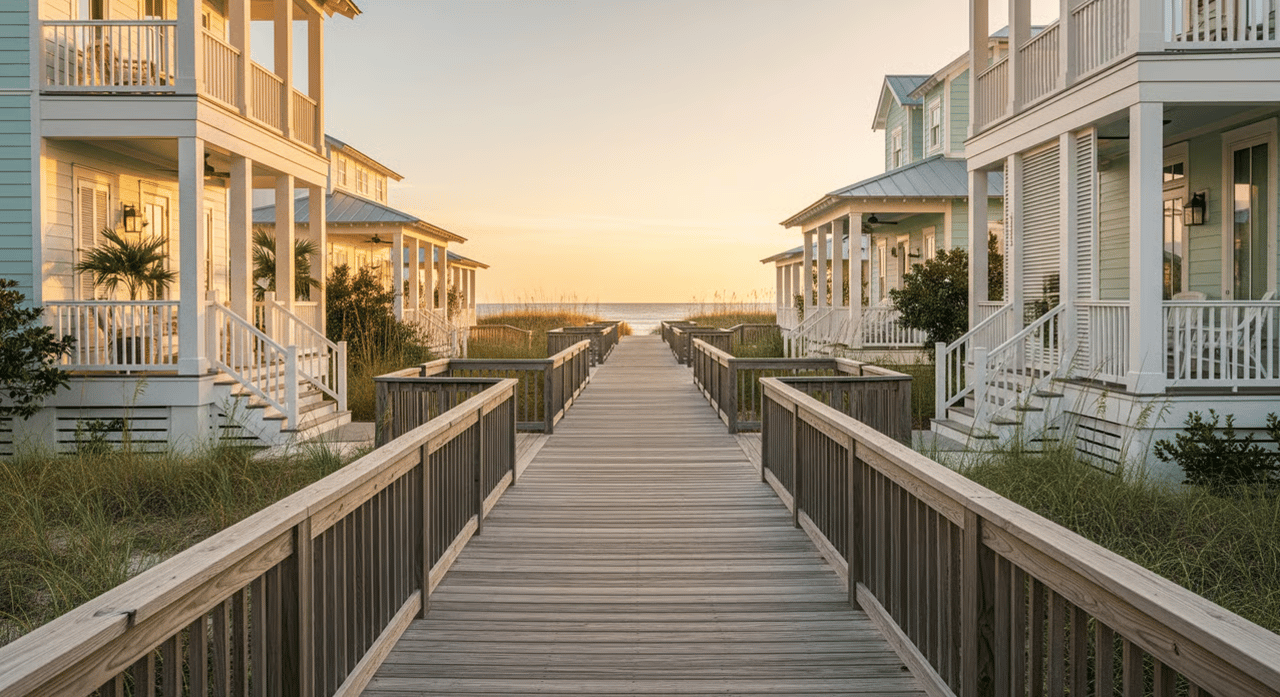
On the Emerald Coast, the story has always been bigger than real estate. It’s the architecture. The coastal dune lakes. The ability to step out of a winter city and into salt air and bike paths. The fact that this coastline has a way of turning “vacation” into “why don’t we just live here?”
2026 is the year that feeling meets a more functional market.
Not a frenzy. A flow.
And in real estate—especially along the Emerald Coast—flow is where wealth gets built quietly, correctly, and ahead of the crowd.